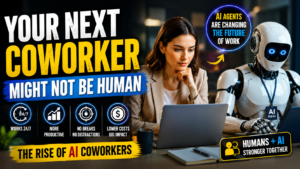
Enterprise AI in 2026: Why Businesses That Ignore AI Will Struggle to Compete


Discover how Enterprise AI, AI agents, and automation are transforming businesses in 2026. Learn key trends, benefits, and future opportunities.
Artificial Intelligence is no longer a future technology.
In 2026, AI has become one of the most important business investments across industries. From startups and software companies to banks, healthcare providers, and global enterprises, organizations are rapidly integrating AI into their daily operations.
The conversation has shifted from:
“Should we use AI?”
to
“How fast can we implement AI before competitors do?”
Recent industry reports show that enterprise AI adoption continues to accelerate as companies seek higher productivity, lower operational costs, improved customer experiences, and better decision-making capabilities. Businesses that successfully integrate AI are already seeing measurable gains in efficiency and performance.
The Rise of AI Agents
One of the biggest trends driving enterprise technology in 2026 is the emergence of AI agents.
Unlike traditional chatbots, AI agents can perform complex workflows with minimal human supervision. They can:
- Analyze business data
- Generate reports
- Automate customer support
- Manage workflows
- Write software code
- Execute repetitive operational tasks
The recent surge in AI agent development has attracted massive investment across the technology industry. Cognition AI recently raised $1 billion while reporting that its AI coding system, Devin, now generates the majority of the company’s internal codebase.
This signals a major shift in how software is developed and how businesses approach automation.
Enterprise AI Is Becoming Business Infrastructure
A few years ago, AI projects were experimental.
Today, AI is becoming core business infrastructure.
Organizations are embedding AI into:
- Customer relationship management (CRM)
- Enterprise resource planning (ERP)
- Marketing automation
- Customer support systems
- Financial analysis
- Human resources
- Cybersecurity operations
Industry analysts increasingly view AI as a foundational technology similar to cloud computing. Businesses delaying adoption risk operating at a structural disadvantage compared to AI-enabled competitors.
Why Microsoft, OpenAI, and Google Are Leading the Race
The enterprise AI market is becoming increasingly competitive.
Microsoft continues expanding its AI ecosystem through Copilot integrations and enterprise cloud services. Google is strengthening its AI offerings with Gemini-powered business tools, while OpenAI continues pushing the boundaries of enterprise AI capabilities.
These companies are investing billions into AI infrastructure because enterprise demand is growing faster than expected.
Organizations want AI systems that can:
- Improve productivity
- Reduce operational costs
- Automate repetitive tasks
- Increase employee efficiency
- Deliver personalized customer experiences
The companies that provide these solutions stand to dominate the next decade of enterprise software.
AI and Cybersecurity: The Next Billion-Dollar Opportunity
As businesses deploy more AI systems, cybersecurity is becoming increasingly important.
Cybercriminals are also leveraging AI technologies, forcing organizations to invest in advanced security platforms capable of defending against sophisticated threats.
This has created significant opportunities for cybersecurity companies focused on:
- AI threat detection
- Zero trust security
- Identity protection
- Cloud security
- AI governance
- Data protection
Investor interest in AI-focused cybersecurity firms has increased significantly throughout 2026 as businesses prioritize security alongside automation initiatives.
AI Infrastructure Is the New Gold Rush
Behind every AI application sits a massive infrastructure layer.
Cloud providers, semiconductor companies, data center operators, and AI platform vendors are all benefiting from explosive demand.
Nvidia recently introduced new AI-focused hardware designed to bring AI capabilities directly to personal computers, highlighting the industry’s move toward local AI processing and autonomous AI agents.
As AI adoption grows, demand for:
- GPUs
- AI servers
- Cloud computing
- Data centers
- AI networking solutions
is expected to remain exceptionally strong.
This infrastructure layer may ultimately become one of the most valuable segments of the AI economy.
The Workforce Transformation Has Already Started
AI is changing how people work.
Rather than replacing entire professions overnight, AI is reshaping workflows by automating repetitive tasks and increasing productivity.
Employees who learn how to work alongside AI tools are likely to gain a significant advantage in the job market. Companies increasingly seek professionals who understand:
- AI automation
- Prompt engineering
- AI-assisted development
- Data analysis
- AI operations
- Machine learning fundamentals
The most successful organizations are focusing on human-AI collaboration rather than complete automation.
What Happens Next?
The next phase of AI adoption will focus on deeper integration.
Businesses will move beyond experimenting with chatbots and begin building AI-first workflows across entire organizations.
We can expect continued growth in:
- Enterprise AI software
- AI agents
- AI cybersecurity
- Cloud AI platforms
- AI infrastructure
- Intelligent automation
The organizations that invest strategically today will be better positioned to compete in an increasingly AI-driven economy.
Final Thoughts
Enterprise AI is no longer a technology trend.
It is becoming a business necessity.
The companies winning in 2026 are not simply using AI tools. They are redesigning operations, workflows, and customer experiences around AI-powered systems.
For business leaders, the question is no longer whether AI will transform their industry.
The question is whether their organization will lead that transformation or struggle to catch up.
Written by