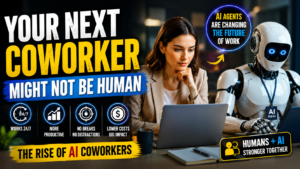
TCS Chairman Says AI Agents Could Match Human Workforce Within 3 Years


TCS Chairman N. Chandrasekaran says AI agents could match the company's human workforce within three years. Here's what it means for the future of work and IT jobs.
The future of work may arrive sooner than most people expected.
Tata Consultancy Services (TCS) Chairman N. Chandrasekaran recently made headlines after predicting that AI agents could eventually match the company’s human workforce within the next three years.
Considering TCS employs nearly 600,000 people worldwide, the statement immediately sparked debate across the technology industry.
Is TCS planning to replace employees with AI?
Will AI agents become digital coworkers?
And what does this mean for the future of IT jobs?
Here’s what Chandrasekaran actually said—and why the entire technology industry is paying attention.
The Bold Prediction From TCS Chairman
Speaking at TCS’s Annual General Meeting, N. Chandrasekaran said the company could have as many AI agents as human employees over the next three years.
The statement reflects a growing belief among technology leaders that AI is moving beyond chatbots and becoming an active participant in business operations.
In simple terms, TCS envisions a future where hundreds of thousands of AI agents work alongside human employees, helping organizations automate tasks, improve productivity, and deliver services faster.
It’s one of the strongest signals yet that enterprise AI is entering a completely new phase.
What Are AI Agents?
Most people are familiar with AI tools like ChatGPT, Gemini, or Copilot.
These tools answer questions and generate content.
AI agents go a step further.
Instead of simply responding to prompts, they can perform actions on behalf of users.
An AI agent can:
- Analyze business data
- Draft reports
- Schedule meetings
- Process support requests
- Monitor systems
- Coordinate workflows
- Interact with multiple software applications
Think of it this way:
A chatbot gives you information.
An AI agent completes the task.
That’s why AI agents are becoming one of the hottest trends in enterprise technology.
Why TCS Is Betting Big on AI
For companies like TCS, artificial intelligence is no longer an experimental technology.
It’s becoming a business necessity.
Organizations worldwide are looking for ways to:
- Increase productivity
- Reduce repetitive work
- Improve customer experiences
- Accelerate digital transformation
- Lower operational costs
AI agents offer a way to achieve all five goals simultaneously.
Instead of hiring large teams for routine processes, businesses can deploy AI agents to handle repetitive tasks while employees focus on strategy, innovation, and customer relationships.
This shift could fundamentally change how IT services are delivered in the coming decade.
Does This Mean AI Will Replace TCS Employees?
This is the question everyone is asking.
The short answer is no.
Chandrasekaran did not say TCS plans to replace its workforce with AI.
In fact, he described AI as a major opportunity rather than a threat.
The vision is not about humans versus AI.
It’s about humans working alongside AI.
Much like calculators didn’t eliminate accountants and cloud computing didn’t eliminate IT professionals, AI agents are expected to change how work is performed rather than eliminate work entirely.
However, the nature of many jobs will evolve.
Routine and repetitive tasks are increasingly likely to be automated, while human workers focus on higher-value responsibilities.
The Bigger Trend Happening Across the Tech Industry
TCS is far from alone.
Some of the world’s largest technology companies are investing heavily in AI agents.
Google is integrating agent capabilities into Gemini and enterprise products.
Microsoft is building AI-powered agents across Microsoft 365 and Azure.
Meta is developing AI agents for customer engagement across its platforms.
OpenAI is working toward more autonomous AI systems capable of completing complex tasks.
The race is no longer about building the smartest chatbot.
The race is about building the most capable AI workforce.
Why This Matters for IT Professionals
For software engineers, system administrators, database professionals, cloud architects, and IT consultants, the rise of AI agents represents both a challenge and an opportunity.
The professionals who understand how to:
- Manage AI systems
- Build AI-powered workflows
- Integrate AI agents into business processes
- Govern AI usage responsibly
will likely become increasingly valuable in the years ahead.
Rather than replacing technical professionals, AI may become a powerful productivity partner.
Those who adapt early could gain a significant advantage.
The Future May Be Hybrid
The most interesting part of Chandrasekaran’s prediction isn’t the number of AI agents.
It’s what that number represents.
For decades, companies measured growth by increasing headcount.
In the future, growth may come from a combination of human talent and AI-powered digital workers.
Organizations may operate with teams consisting of both employees and AI agents working together.
If that happens, the workplace of 2030 could look dramatically different from the workplace of today.
Final Thoughts
When TCS Chairman N. Chandrasekaran says AI agents could match the company’s human workforce within three years, it’s not just a prediction about TCS.
It’s a glimpse into where enterprise technology is heading.
The next generation of artificial intelligence won’t simply answer questions.
It will complete tasks, automate workflows, and work alongside humans at an unprecedented scale.
Whether that future arrives in three years or five, one thing is becoming increasingly clear:
AI agents are no longer a futuristic concept.
They are rapidly becoming part of the modern workforce.
Written by