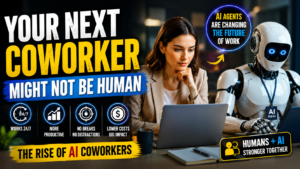
AI Is Replacing Jobs Faster Than Anyone Predicted — Are You Next? (2026)


AI job replacement is no longer a prediction — it's happening now. Discover the 10 jobs AI is already replacing in 2026, which careers are safe, and a 5-step plan to protect your income.
AI job replacement is no longer a prediction — it’s happening now. Discover the 10 jobs AI is already replacing in 2026, which careers are safe, and a 5-step plan to protect your income.
The robots didn’t come for us in the movies. They came in a browser tab.
You’ve heard the warnings for years. “AI will take jobs.” “Automation is coming.” But here’s what nobody told you: it’s not coming anymore. It arrived. Goldman Sachs Research estimates AI could expose the equivalent of 300 million full-time jobs to automation worldwide. The IMF puts nearly 40% of all global employment in the crosshairs — rising to 60% in advanced economies.
But here’s the part the doom-and-gloom headlines miss: this story has two sides. Yes, jobs are disappearing. But entirely new categories of work are opening up. The difference between people who thrive and those who get left behind comes down to one thing: knowing which side of the line you’re standing on.
This guide will tell you exactly that. No fluff. Just the data, the specific jobs being replaced, and a clear action plan to future-proof your career.
Why 2026 Is the Inflection Point Nobody Saw Coming
For most of the last decade, AI was a background technology — it recommended Netflix shows and filtered spam. Then the dam broke. Generative AI burst into public consciousness, and every major corporation scrambled to embed it into their workflows.
The result? An acceleration that surprised even the researchers who built these systems. The World Economic Forum’s Future of Jobs Report named bank tellers, data entry clerks, cashiers, and administrative assistants among the fastest-declining roles of the 2025–2030 period. Financial institutions alone cut nearly 10,000 jobs in Q1 2026.
The question was never if. It was always when — and the answer, in 2026, is now.
The 10 Jobs AI Is Already Replacing Right Now
These aren’t predictions. These are roles where displacement is already documented, measurable, and accelerating.
1. Customer Service Representative
AI chatbots now resolve up to 80% of common customer queries without any human involvement. They work 24/7, never get frustrated, and handle thousands of simultaneous conversations. Tools doing this right now: ChatGPT Enterprise, Intercom Fin, Zendesk AI.
2. Data Entry Clerk
Structured, repetitive data work is automation’s bread and butter. AI tools extract information from documents and populate databases at speeds no human can match — for pennies per task. Tools: UiPath, Microsoft Power Automate, Google Document AI.
3. Junior Content Writer
AI generates blog posts, product descriptions, social captions, and email sequences at scale. Businesses that once hired teams of junior writers now use one editor and an AI tool. Tools: Claude, ChatGPT, Jasper, Writesonic.
4. Payroll & Accounting Clerk
AI-powered accounting software automates billing, invoices, payroll, tax filing, and reconciliation. The role of “entering numbers” is essentially obsolete. Tools: QuickBooks AI, Xero, Pilot, Intuit Assist.
5. Junior Market Research Analyst
Pulling datasets, spotting trends, and preparing initial reports — these are perfectly structured tasks for AI. Advanced analytics platforms now generate polished insights in minutes, not days. Tools: Tableau AI, Google Looker, Perplexity Pro.
6. Bank Teller & Loan Officer
Mobile banking plus AI fraud detection and automated loan approval have been eroding this role for years. Financial institutions cut nearly 10,000 jobs in Q1 2026 alone. Tools: Zest AI, Upstart, Blend.
7. Administrative Assistant
Scheduling meetings, summarizing calls, managing inboxes, drafting emails — AI handles all of this now. The “calendar Tetris” that once consumed hours is a one-line prompt. Tools: Motion, Notion AI, Microsoft Copilot.
8. Junior Software Developer
AI coding assistants generate entire codebases from plain-English descriptions. Entry-level tasks — boilerplate, bug fixes, unit tests — are increasingly done without a human typing a single line. Tools: GitHub Copilot, Cursor, Claude Code.
9. Legal Assistant & Paralegal
AI tools read contracts, flag anomalies, summarize clauses, and research case law in seconds. Document review that once took junior associates days now takes minutes. Tools: Harvey AI, Lexis+ AI, Clio Duo.
10. Telemarketer & Cold Caller
AI voice agents make hundreds of calls per hour, respond dynamically to objections, and never have a bad day. The economics of human telemarketers simply cannot compete. Tools: Synthflow, VAPI, Air.ai.
“AI loves repetition. Anything rule-based or predictable is easily automated. Ask yourself — could someone describe my job in a detailed prompt? If yes, it’s vulnerable.”
The Jobs AI Cannot Replace (Yet)
Here’s the good news nobody talks about loudly enough: AI has hard limits. It cannot build trust with a frightened patient. It cannot read a room full of people. It cannot fix your burst pipe. The safest jobs in the AI era share at least one of four traits — they require physical dexterity, deep human empathy, creative originality, or complex judgment in unpredictable situations.
Jobs that remain safe in 2026:
- Mental Health Therapist — Trust, empathy, and human connection are irreplaceable. AI cannot build a therapeutic alliance.
- Skilled Trades (Plumber, Electrician, HVAC) — Physical work in unpredictable environments. Robots aren’t navigating your crawl space anytime soon.
- Registered Nurse — Clinical judgment + physical care + human compassion. AI assists; it doesn’t replace bedside presence.
- Creative Director — Strategy, taste, and cultural instinct. AI generates; humans decide what’s worth generating.
- Trial Lawyer — Courtroom persuasion, reading jurors, and ethical judgment under pressure remain deeply human skills.
- Teacher & Educator — Motivation, mentorship, and adapting to individual students in real time. AI tutors assist; they don’t inspire.
- AI Prompt Engineer / AI Strategist — The meta-job: directing AI tools to get maximum value. Entirely new and in massive demand.
- Civil Engineer — Integrating safety, regulations, physics, and community needs with real-world consequences.
The Real Pattern: Tasks Are Replaced, Not Entire Jobs
Here’s a nuance the clickbait headlines consistently miss. For most roles, AI isn’t flipping a switch and deleting the job entirely. It’s eliminating the repetitive, rule-based tasks within a role — and leaving the complex, judgment-heavy parts to humans.
A radiologist isn’t gone. But the one spending 4 hours reviewing standard scans? That part of their day is shrinking fast. A financial analyst isn’t gone. But the one who spent 60% of their week pulling data and formatting PowerPoints? Those hours are being automated.
Your survival strategy isn’t about finding a completely robot-proof job. It’s about deliberately moving toward the higher-judgment parts of your existing role — before your employer does it for you.
The key question to ask yourself: “Which parts of my workday could I describe in a detailed prompt to an AI?” Those parts are vulnerable. The parts you can’t easily describe are your competitive advantage. Protect them. Develop them. Double down on them.
Your 5-Step Plan to Future-Proof Your Career
Step 1 — Audit your own role Write down every task you do in a week. Mark which ones could be replaced by a well-written AI prompt. Be brutally honest. That list is your vulnerability map.
Step 2 — Become an AI power user in your field The people who won’t be replaced by AI are the ones using AI better than anyone else. Learn the tools already entering your industry. Use them daily. The goal is to be the person who makes AI 10x more useful — not the person AI makes redundant.
Step 3 — Invest in skills AI can’t automate Communication, leadership, creative problem-solving, emotional intelligence, and ethical judgment. These are your moats. Build them deliberately and continuously.
Step 4 — Niche down into complexity The more specialized and context-dependent your expertise, the harder it is to automate. Don’t be a generalist in a world of AI generalists. Be the expert humans call when the AI gets it wrong.
Step 5 — Build an audience or reputation now Trust is the scarcest resource in an AI-saturated information environment. A person known for insight, honesty, and quality judgment is more valuable than ever. Start building that reputation through writing, speaking, or teaching — today.
The New Jobs AI Is Creating
Every major technological revolution destroys some jobs and creates others. The internet killed travel agents and created SEO specialists, UX designers, and social media managers. AI is no different.
Right now in 2026, demand is surging for roles that barely existed two years ago:
- AI Prompt Engineer — designing inputs that get reliable, high-quality outputs
- AI Workflow Designer — building automated pipelines connecting AI tools to business processes
- AI Ethics & Compliance Officer — ensuring AI systems operate within legal and ethical boundaries
- AI Content Strategist — guiding what AI produces, editing for quality, maintaining brand voice
- Human-AI Interaction Designer — creating experiences that blend human and AI collaboration
- AI Trainer & Red Teamer — testing AI systems for failure modes and vulnerabilities
None of these required a special degree. They required people who understood both the human side and the AI side well enough to bridge them. That’s a skill you can start building today.
The Bottom Line
The IMF estimates 60% of jobs in advanced economies are exposed to AI. That number isn’t a death sentence — it’s a call to action. Exposure doesn’t mean replacement. It means transformation.
The workers who will thrive aren’t the ones who pretend AI doesn’t exist. They’re not the ones who panic and freeze. They’re the ones who look at these tools clearly, understand where they’re powerful and where they’re limited, and deliberately position themselves in the space AI cannot fill.
That space is enormous. Everything that requires trust, judgment, creativity, physical presence, and genuine human connection. Your job is to find your version of that space — and own it.
Did this article help you? Share it with someone whose career could use a reality check right now. And drop your job title in the comments — we’ll tell you honestly how much AI risk it carries.
Written by